
Case Study / Automotive
Launching Acura's First
Electric Vehicle Online
Acura was making one of the boldest bets in its history: launching the ZDX — its first-ever electric vehicle — through an exclusively online purchase model. The challenge was solving two compounding trust problems simultaneously: convincing skeptical buyers that EVs were practical and worth the premium, and convincing those same buyers to complete a high-consideration luxury purchase entirely online. I led the UX strategy for the ZDX launch, defining the research program, persona framework, and experience architecture that gave Acura a credible path to both.
with EV education & trust content
making mobile-first non-negotiable
the full awareness-to-advocacy journey
Strategic Challenge
The ZDX launch put Acura at the intersection of two difficult consumer psychology problems. First: EV skepticism. Despite rapidly growing market adoption — U.S. EV registrations tripled between 2016 and 2020, and the market was projected to reach $139B by 2027 — a meaningful segment of Acura's own customer base still associated electric vehicles with uncertainty: range anxiety, unfamiliar technology, charging infrastructure gaps, and a premium price tag they weren't sure was justified. Second: online-only car buying. The traditional dealership experience, for all its friction, gave buyers tactile reassurance. Removing it entirely created a trust deficit the digital experience had to close on its own.
"The ZDX wasn't just a new vehicle launch. It was a new sales model, a new vehicle category, and a new relationship between Acura and its buyers — all at once."
Acura's existing digital experience was built for a world where the dealership closed the sale. Content was organized around the car, not the customer's decision process. For the ZDX, the website had to do what the showroom floor used to do: build trust, answer objections, guide configuration, and convert — without a sales rep in the room. My mandate was to define how.
Research Strategy
I designed a multi-method discovery program to diagnose both trust problems with precision before recommending any solution direction. The research had to answer two questions simultaneously: what does a buyer need to believe about EVs before they'll consider one, and what does a buyer need to believe about the process before they'll complete a luxury purchase online?
Method 01
Search Behavior Analysis
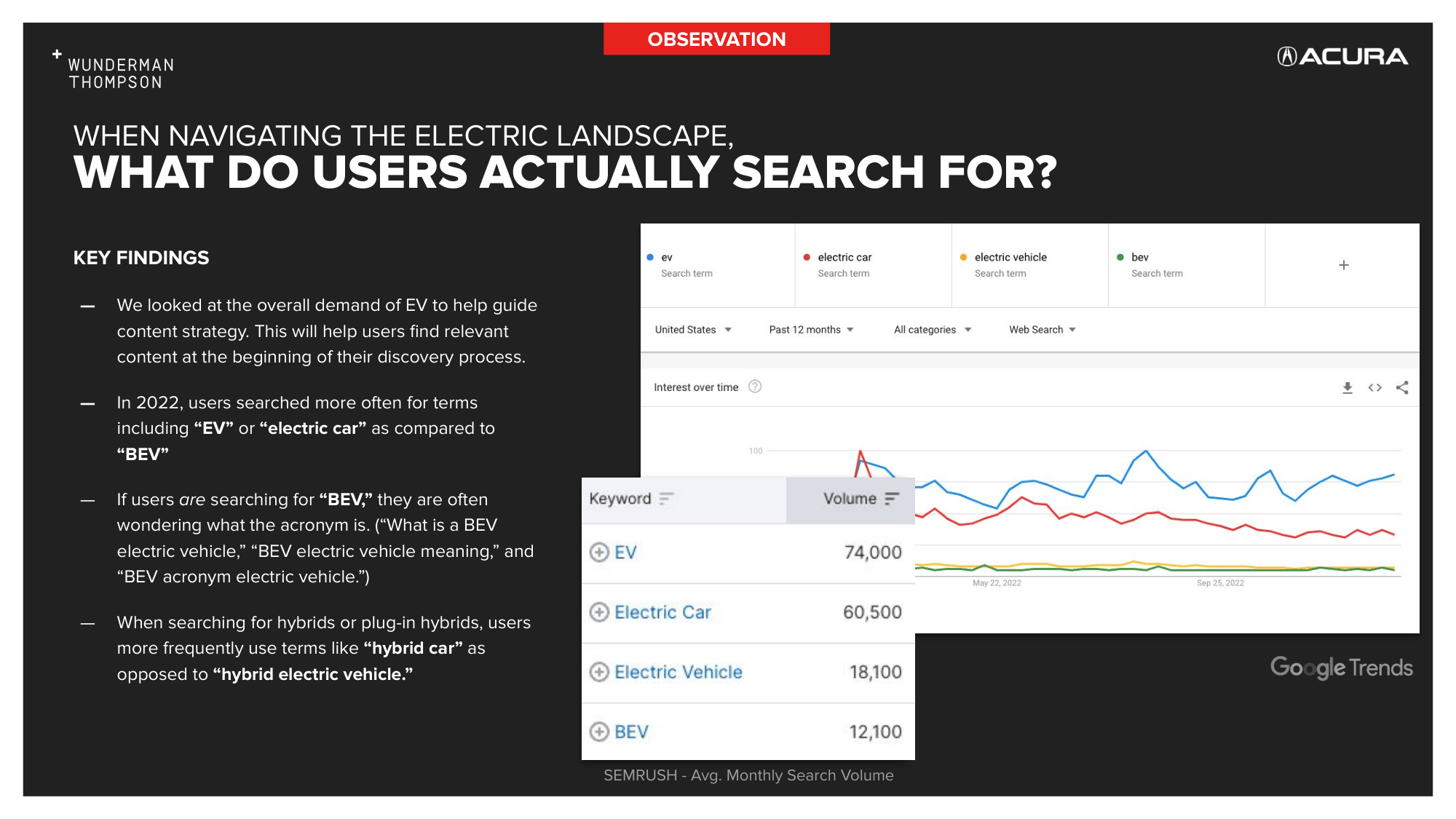
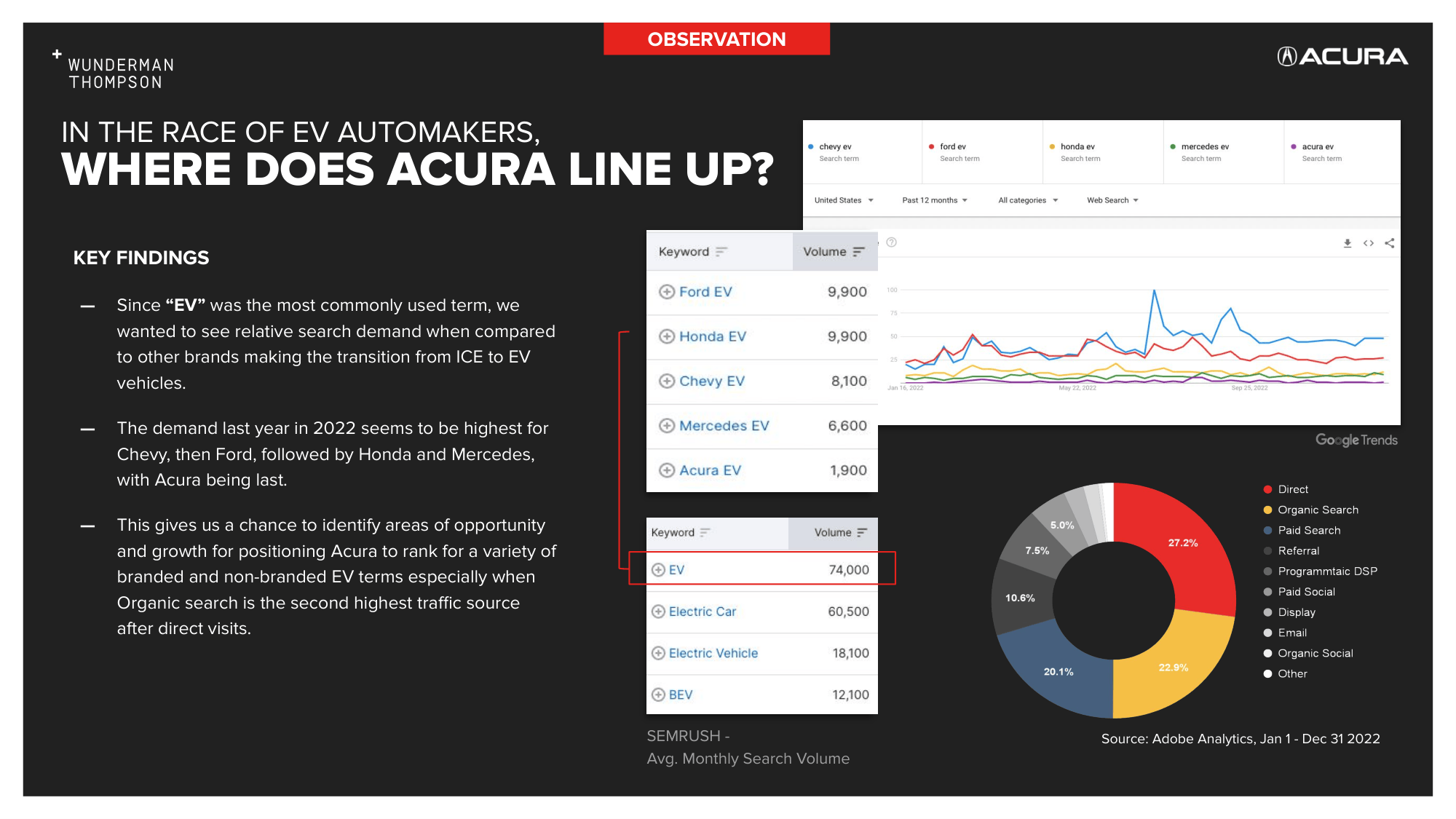
Used SEMrush and Google Trends to map how prospective EV buyers actually navigate the category online. Critical finding: buyers predominantly search "EV" and "electric car," not "BEV" — the term Acura's internal teams defaulted to. A language misalignment between Acura's content and how customers entered the category, with direct SEO and content strategy implications.
Method 02
Pain Point Audit
Analyzed the most common EV-related search queries to build a precise map of buyer anxieties: tax credit mechanics, home charger costs, charging infrastructure reliability, autonomous feature safety. Each objection became a content requirement that had to be answered somewhere in the experience architecture before conversion was possible.
Method 03
Funnel Analytics
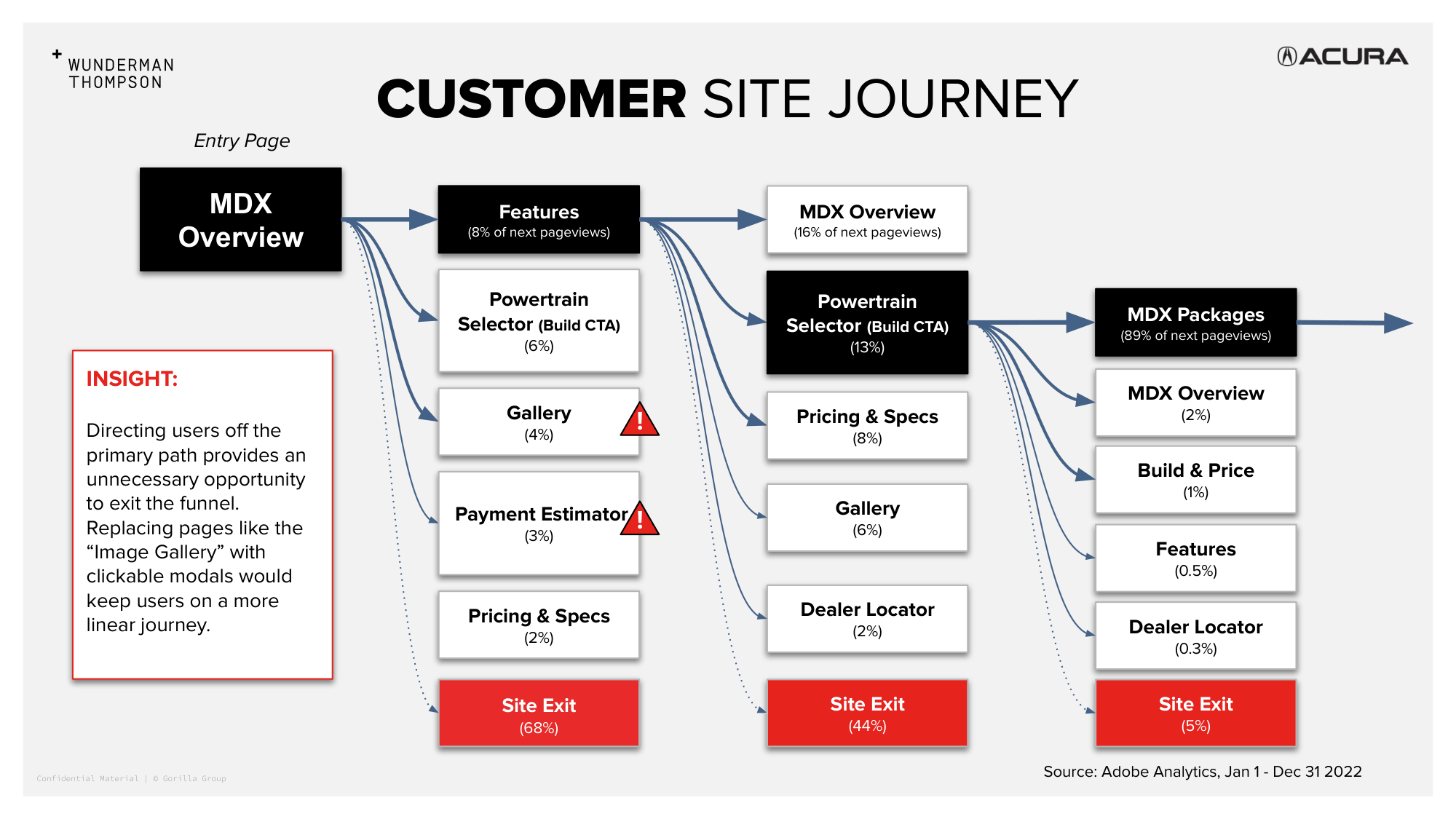
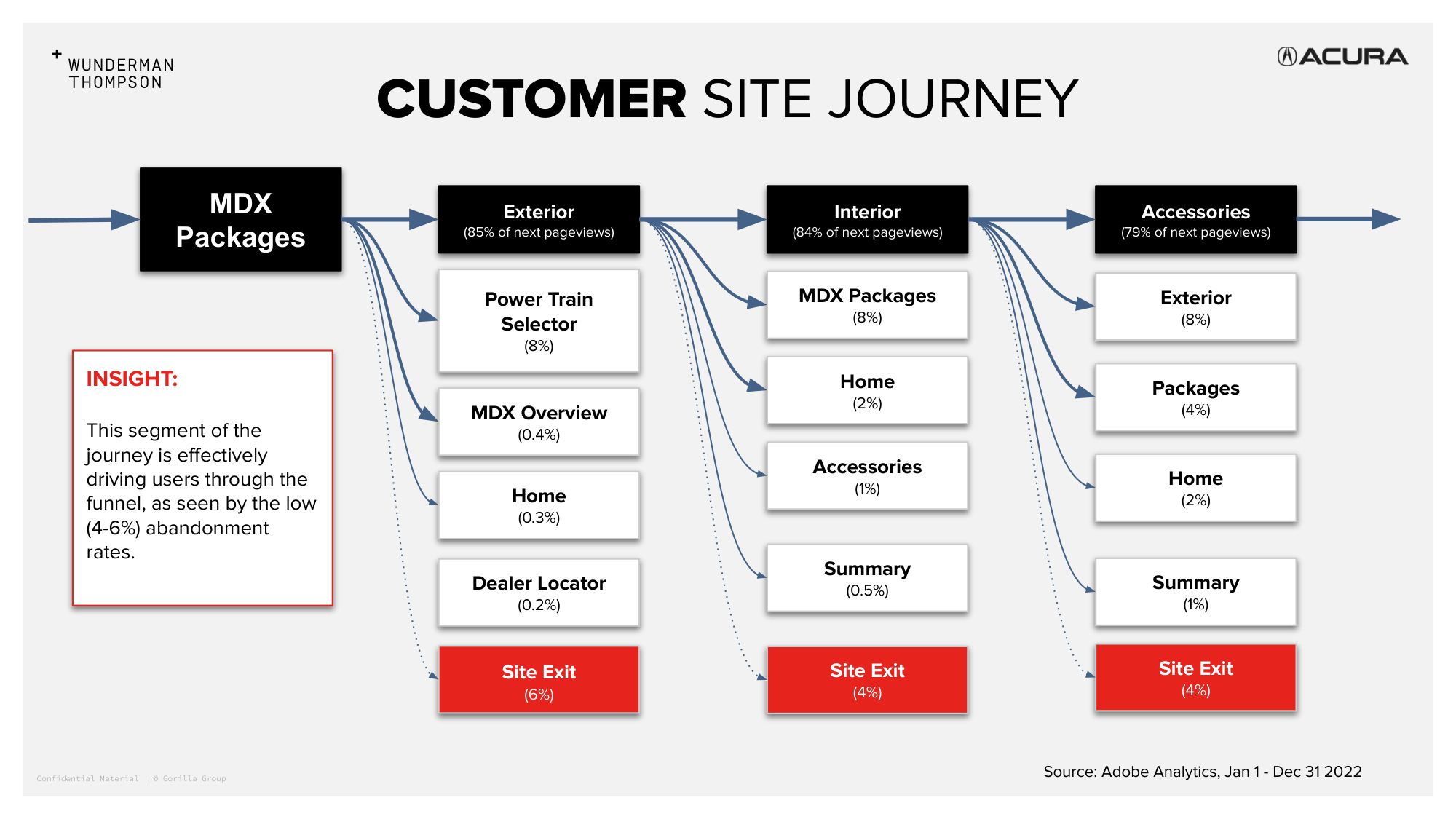
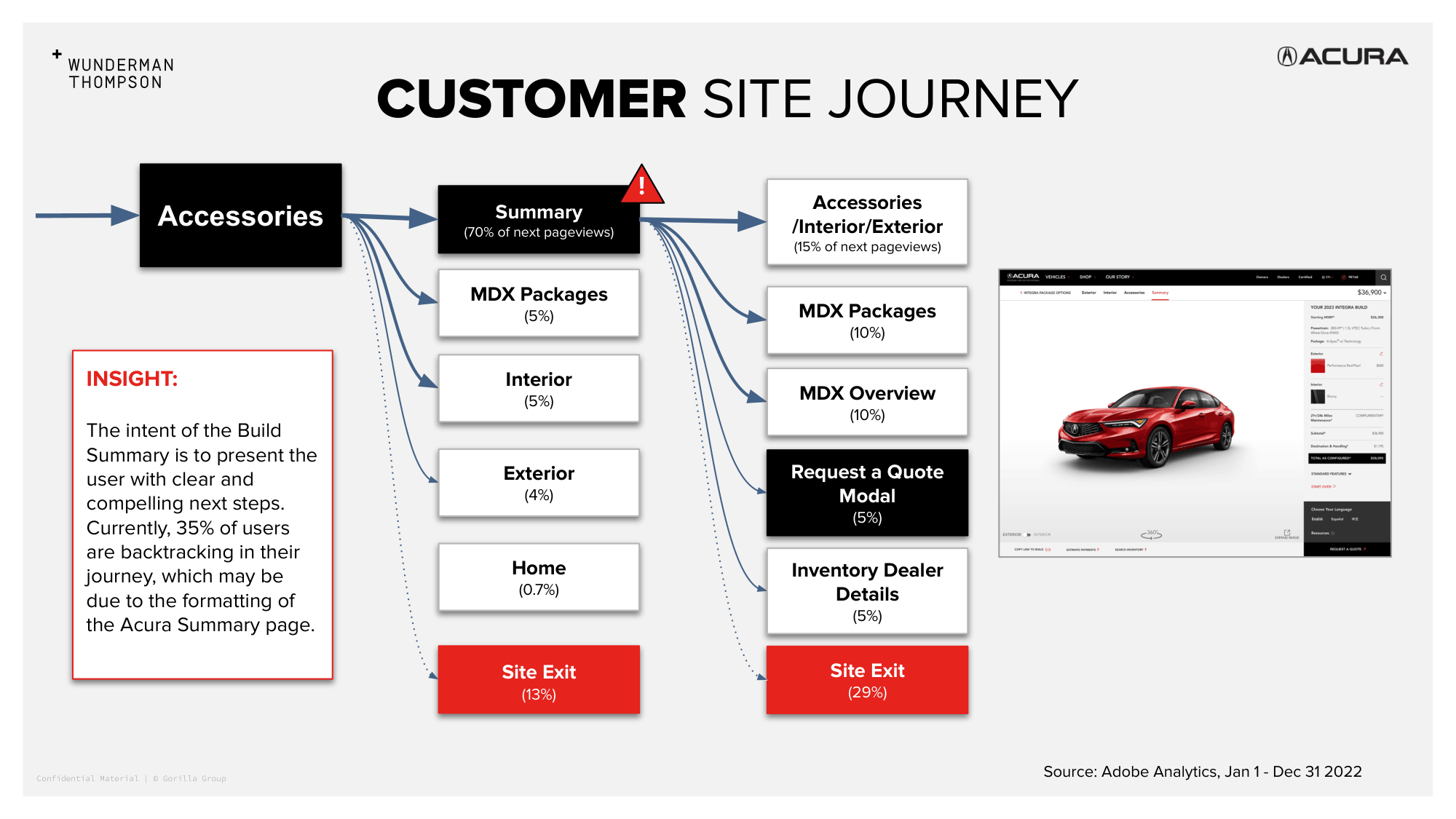
Adobe Analytics data on the existing vehicle purchase journey revealed a structural problem: 68% of users were exiting the site after the first step off the overview page. The issue wasn't conversion optimization — the current journey created unnecessary off-ramp opportunities that interrupted momentum before it could build.
Audience Definition
I developed three personas mapped to the specific trust barriers each buyer type needed Acura to resolve before any purchase decision was possible. The distinction between them wasn't demographic — it was the nature of the doubt they carried into the experience, and therefore the nature of the content intervention required.
Persona 01
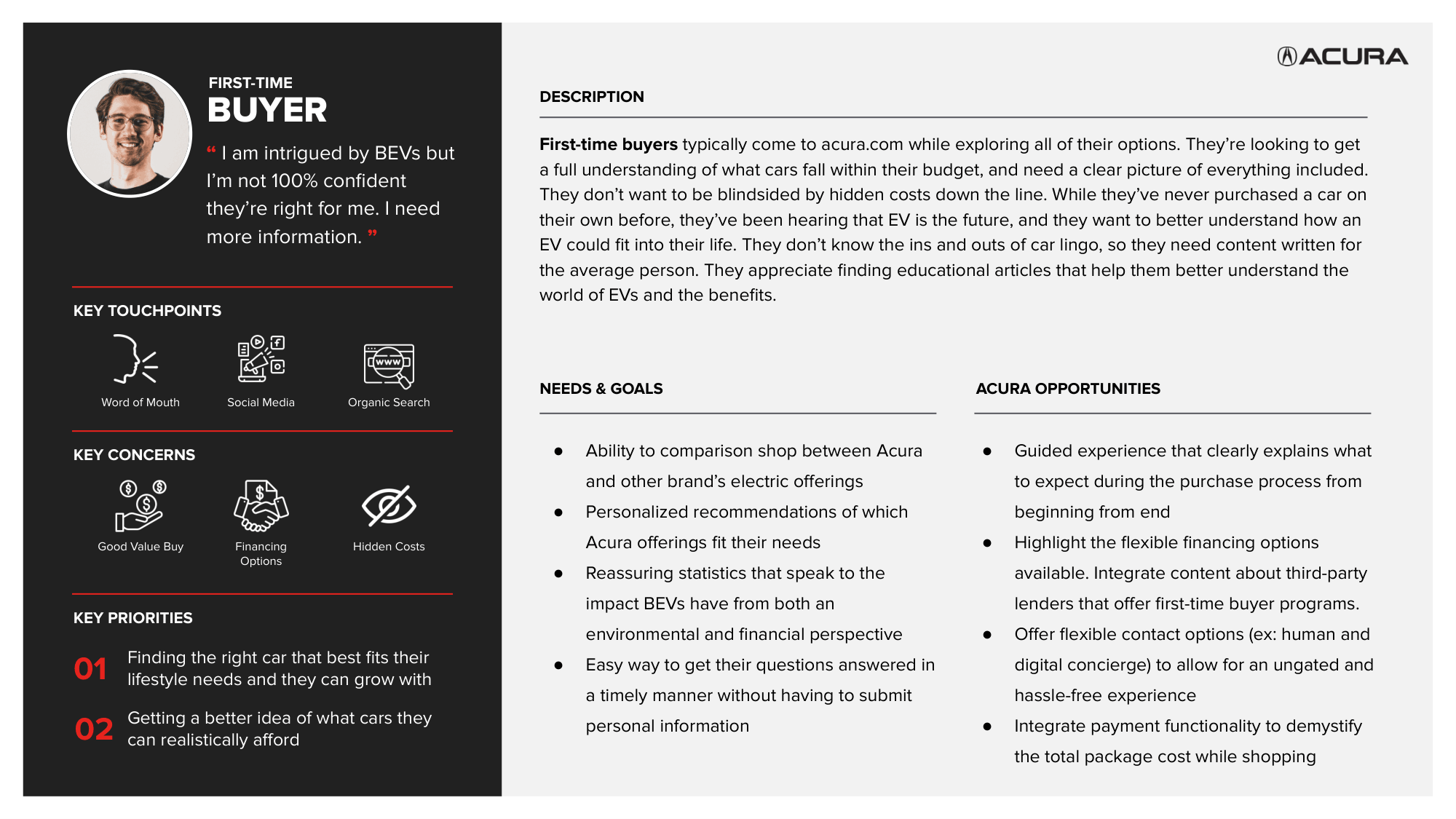
First-Time Buyer
EV-curious, first car purchase, intimidated by the complexity of both the category and the transaction. The design challenge: demystify the vehicle, the technology, and the purchase process simultaneously — without assuming any prior knowledge.
- Transparent, jargon-free pricing with no hidden costs
- Financing content surfacing first-time buyer programs proactively
- End-to-end purchase process explained before commitment is required
- Ungated contact options — answers without form submissions
Persona 02
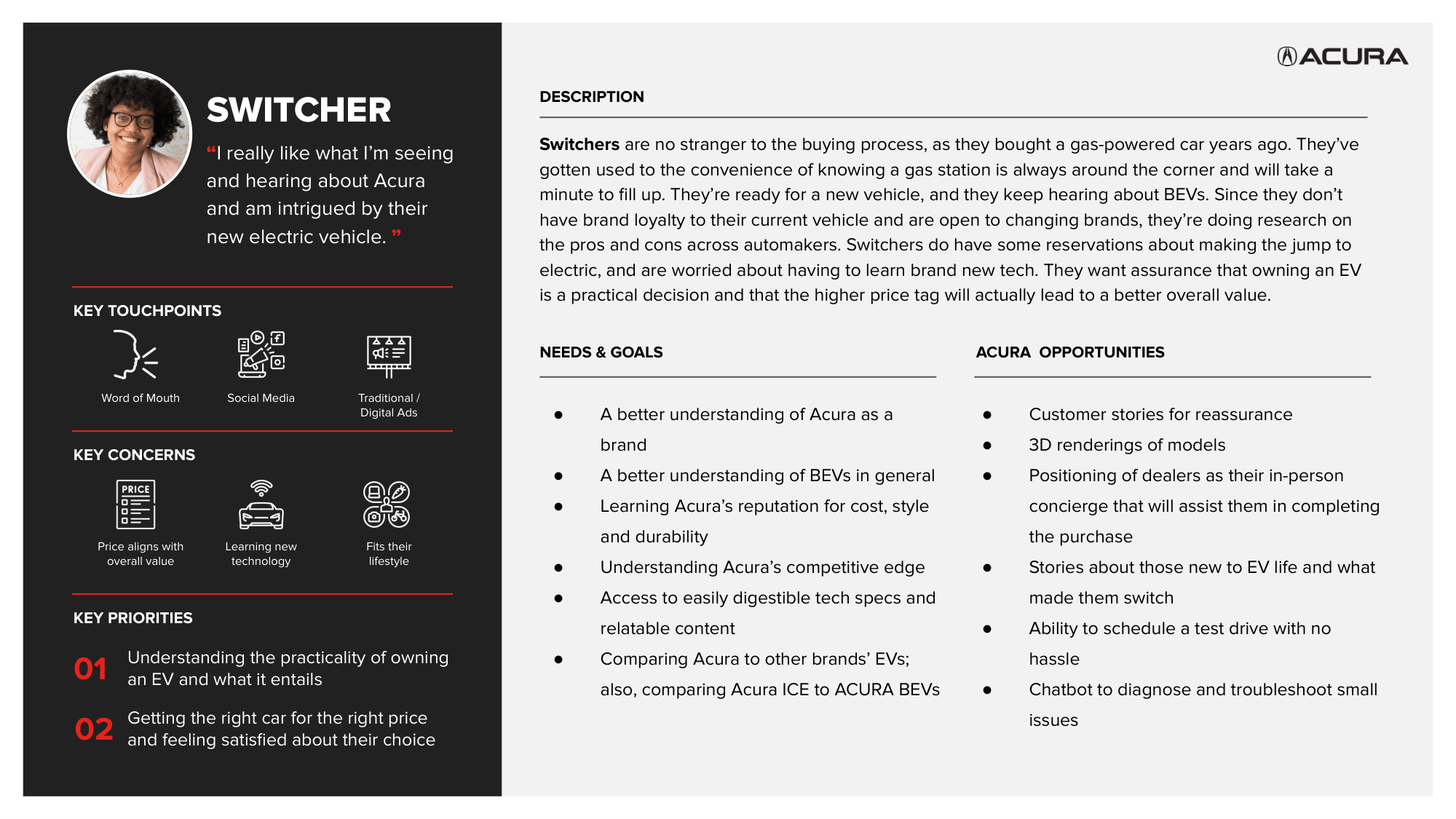
Switcher
Experienced buyer, no brand loyalty, EV-curious but unconvinced. The design challenge: validate that the switch is worth it and that Acura specifically earns their consideration over competitors also entering the EV space.
- Acura ICE vs. Acura BEV head-to-head comparison
- Real customer switch stories, not marketing testimonials
- Frictionless test drive scheduling as a low-commitment first step
- Dealer positioned as in-person concierge, available on the buyer's terms
Persona 03
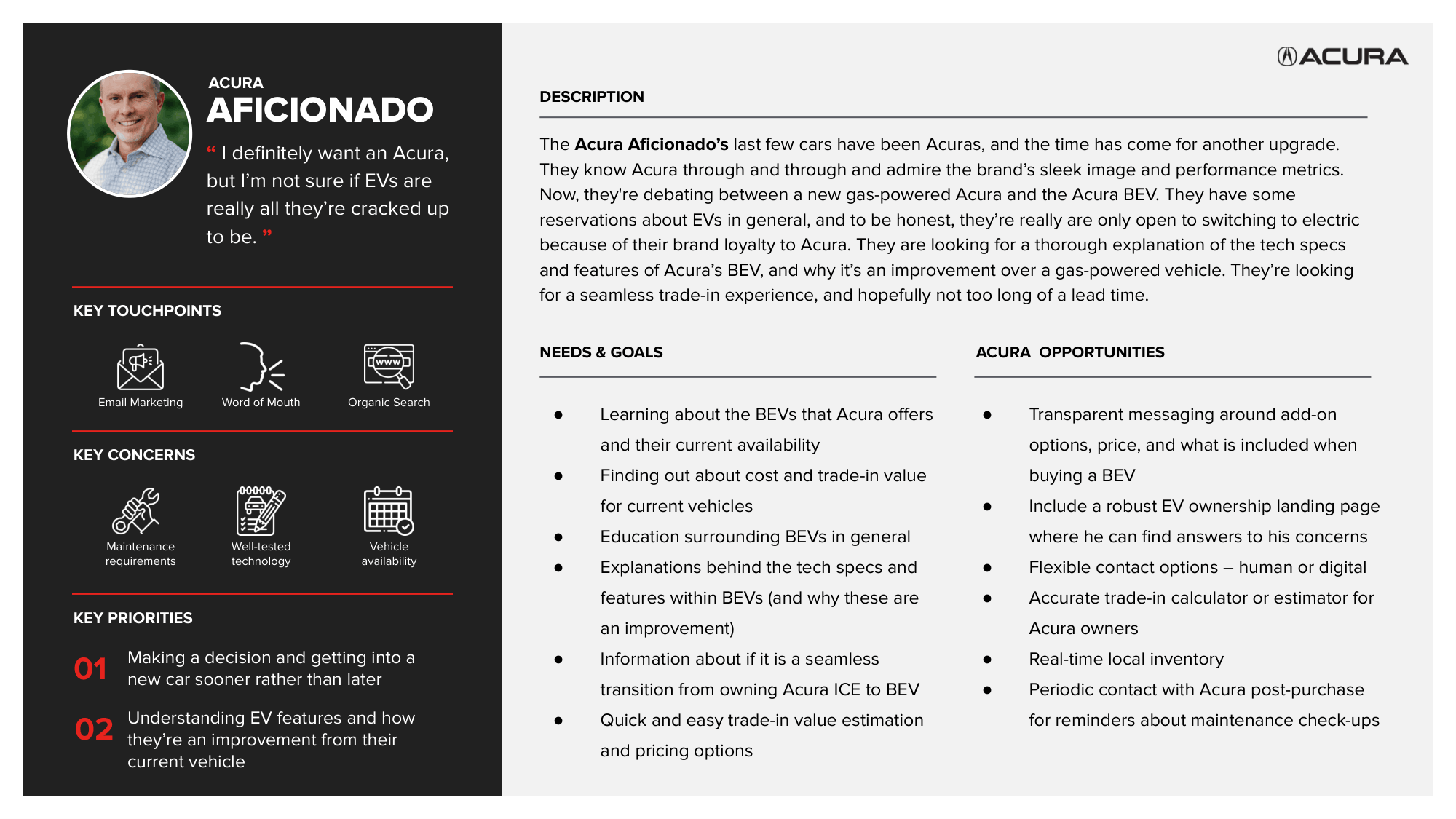
Acura Aficionado
Loyal Acura customer debating between the ZDX and another gas-powered Acura. The design challenge: frame EV adoption through the lens of brand continuity. This user needs to feel the ZDX is the natural next Acura — not a leap into the unknown.
- BEV feature explanations anchored to what they know from Acura ICE
- Accurate trade-in estimator — this buyer is impatient and expects efficiency
- Real-time local inventory — lead times matter more than anything else
- EV ownership hub answering their specific technical concerns upfront
Experience Strategy
The research phase surfaced a clear strategic frame: the ZDX online experience needed to function as a trust engine before it could function as a purchase funnel. Six strategic directions shaped the prototype and MVP, each directly traceable to a specific finding from the research.
Meet Buyers in Their Language
Use "EV" throughout the experience, not "BEV." Search data showed 74,000 monthly searches for "EV" versus 12,100 for "BEV." Content terminology had to reflect buyer behavior, not Acura's internal product taxonomy. Hybrid-curious users were guided toward the EV overview rather than allowed to exit the funnel.
Build a Dedicated EV Ownership Hub
A single, central page addressing the most common buyer objections — home charger installation, public charging infrastructure, autonomous feature safety, long-term savings — with spinoff pages for deeper dives. The trust-building infrastructure the experience was missing before any purchase conversation could begin.
Eliminate Funnel Exits
Analytics showed 68% of users were exiting at the first step off the overview page. Replacing standalone gallery and payment estimator pages with in-context modals kept users on the primary path. A structural fix with a direct impact on conversion probability, validated before a single design was built.
Personalize by Audience and Location
Deliver family-oriented, performance-oriented, and EV-interest content based on behavioral signals. Use location data to surface state-specific tax incentives and local dealer information — two of the highest-value pieces of content for converting intent into action, identified directly from search behavior analysis.
Redesign the Purchase Flow End-to-End
An integrated online purchase experience — vehicle configuration tool, transparent pricing, virtual consultation, 360° visualization, streamlined checkout — designed to maintain momentum through trade-in, financing, and final purchase without creating the decision-point friction that was bleeding users from the existing funnel.
Reposition the Dealer Relationship
The online model didn't eliminate the human element — it repositioned it. Dealers became in-person concierges available to support the digital journey on the buyer's terms, rather than a required step that signaled the end of the customer's control over the process.
Outcomes & Impact
Early prototype testing validated the core strategic bets before any production build began. The results gave Acura's stakeholders the confidence to proceed with the full ZDX digital experience built on the strategic foundation defined in this engagement.
20% Engagement Lift
Prototypes that directly addressed EV ownership concerns drove a 20% increase in engagement over earlier digital touchpoints — validating the trust-first content strategy before a single line of production code was written.
EV Trust Framework
A content and experience architecture purpose-built to convert skeptics — grounded in real buyer language and real buyer objections, not assumptions about what EV messaging should be. A reusable strategic foundation for future EV launches in Acura's portfolio.
Three Personas, Seven-Phase Journey Maps
From awareness through post-purchase advocacy, with specific digital opportunity recommendations mapped to each phase for each persona — giving Acura's product and content teams a decision framework that extended well beyond the ZDX launch.
Funnel Architecture & Personalization Strategy
A purchase flow eliminating the exit-point failures identified in analytics, and an audience segmentation model enabling Acura to deliver context-relevant content by buyer type, behavioral signal, and location — giving the platform the intelligence to serve the right message at the right moment.