
Case Study / Agribusiness
Redefining the Customer
Experience for J.R. Simplot
J.R. Simplot is one of the largest privately held agribusinesses in the United States — phosphate mining, food processing, agriculture, ranching, operations across four continents. The strategic problem wasn't a single customer experience failure. It was fragmentation: multiple lines of business, each with their own customer relationships, operating without a shared understanding of who Simplot's customers were or what they needed. I led a three-month Discovery engagement to build the research foundation for One Simplot — an enterprise-wide customer experience strategy that could work across every division without flattening the real differences between them.
8 lines of business
and external customers
a single unified framework
Strategic Challenge
Simplot's challenge was structural. Grower Solutions, Agribusiness, Food Group, and the company's other divisions each served fundamentally different customer types — from independent farmers buying inputs to large food manufacturers managing supply chains. These divisions had built their own assumptions about their customers over decades, largely in isolation from each other.
"There was no shared language for who Simplot's customers were — and no foundation for the kind of enterprise-wide transformation the One Simplot vision required."
Before any digital or operational change could happen at scale, Simplot needed a unified understanding of its customer base that was rigorous enough to be trusted and flexible enough to be actionable across very different business contexts. The deliverable wasn't a set of personas and journey maps. It was a shared organizational model — the prerequisite for every strategic decision that followed.
Research Strategy
I structured the discovery program around a core challenge: how do you build enterprise-wide insight without losing the specificity that makes each division's customer relationships meaningful? The research design operated at two levels simultaneously — surfacing shared patterns across the business while preserving the nuance that made each segment distinct.
Method 01
Customer & Stakeholder Interviews
Directed 49+ hour-long sessions engaging 84 total participants — 26 internal Simplot stakeholders and 23 external customers across 8 lines of business, with many sessions structured as working groups to capture cross-functional dynamics. The research ran a parallel track alongside the customer program: a separate set of sessions with HR leaders and new hires to understand the employee experience, recognizing that customer-facing transformation depends on operational alignment from the inside out. Discussion guides were built around the full customer lifecycle and designed to be adaptive — updated in real time as new patterns emerged, so the research stayed responsive to what we were learning rather than locked to initial assumptions.
Method 02
Affinity Mapping & Synthesis
With that volume of qualitative data, synthesis was as important as collection. Led the team through an affinity mapping process that clustered pain points, surfaced recurring patterns, and separated the themes that were truly enterprise-wide from those specific to individual divisions. The synthesis produced four themes consistent enough across the business to anchor the entire engagement.
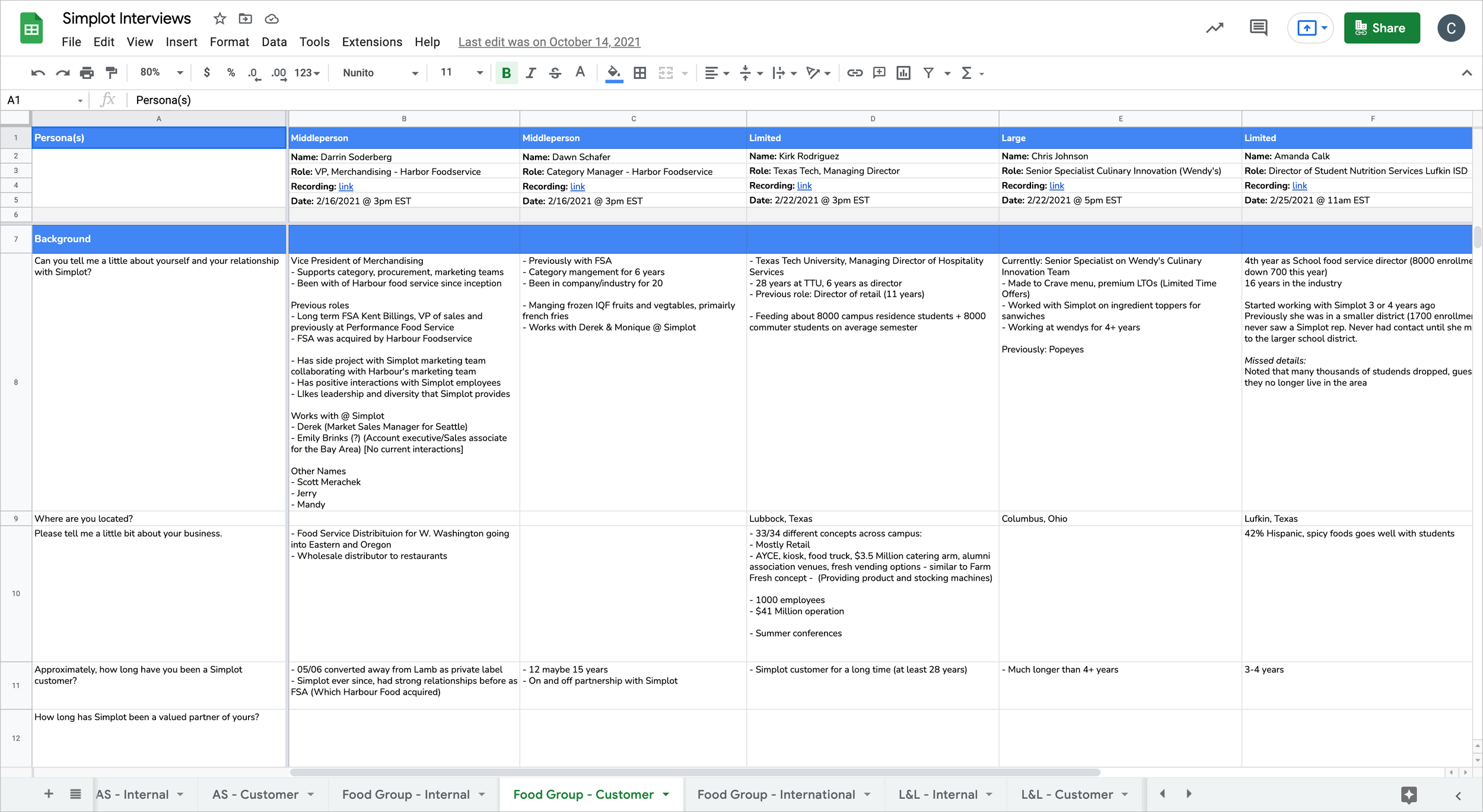
Interview notes — 84 participants across 8 lines of business, tracked in real time and updated as patterns emerged across sessions
Research Scope
Who We Talked To
49 sessions. 84 participants. Every line of business covered — both the people who sell Simplot products and the people who buy them.
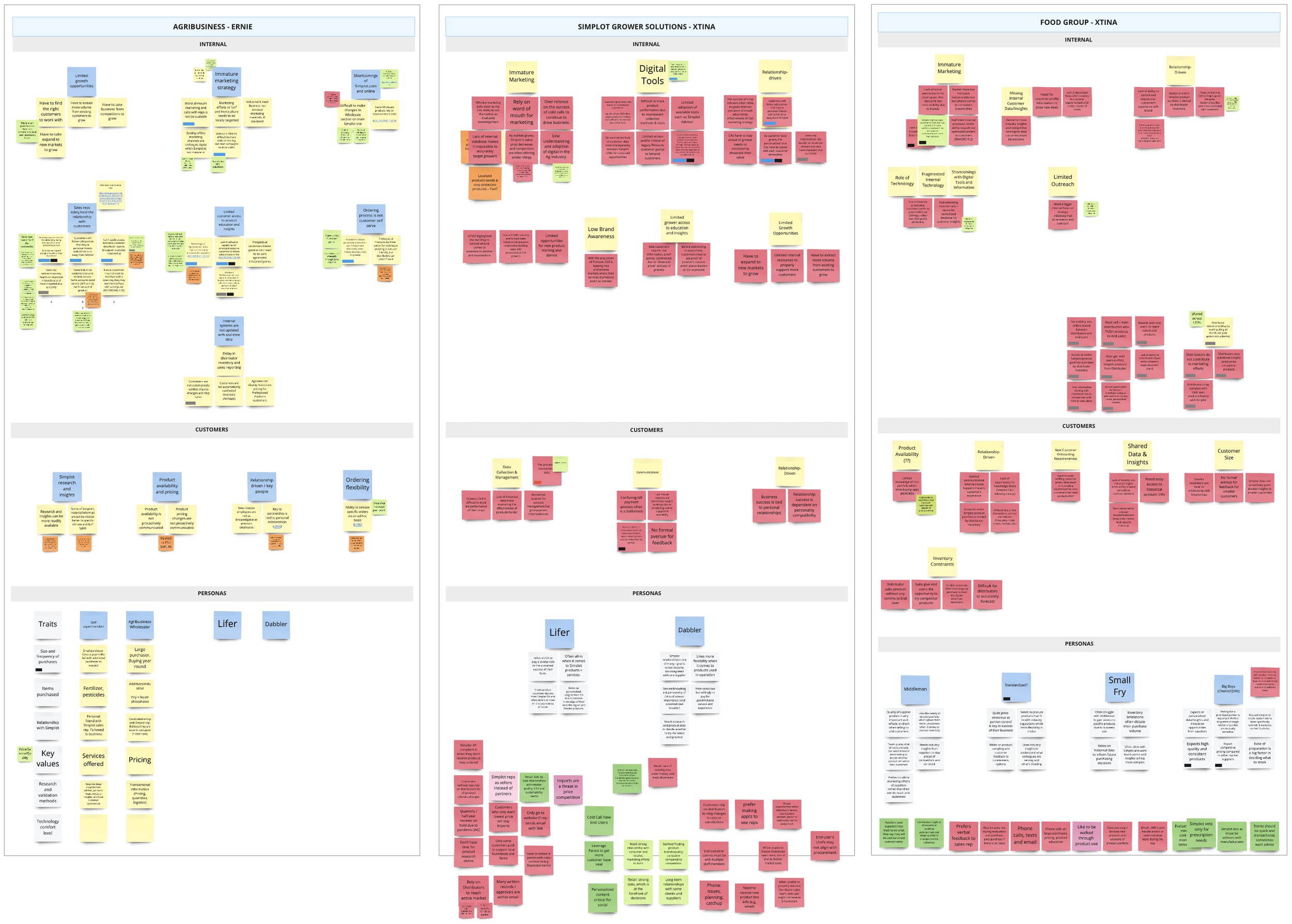
Affinity mapping in Miro — synthesis across three divisions, clustering 84 participants' pain points into enterprise-wide themes
What the Research Revealed
Four themes emerged with enough consistency across divisions and customer types to function as enterprise-wide strategic priorities. Each was grounded in direct customer evidence — not assumptions about what a company this size should be doing.
Self-Service Demand
Particularly among smaller customers, a growing expectation of autonomy — the ability to place orders, access support, and retrieve information without requiring a human touchpoint. Simplot's current model required too much friction for customers whose needs were routine and well-defined.
Marketing Gaps
Materials — both digital and physical — weren't reaching the right customers in the right format at the right moment. The gap wasn't content quality; it was distribution and targeting. Customers with high purchase intent were under-served while resources were being directed at segments less likely to act.
Inaccessible Expertise
Simplot's depth of agronomic and industry knowledge was one of its most significant competitive assets — and customers consistently reported they couldn't access it. The expertise existed internally but wasn't making its way to the customers who needed it most to make informed decisions.
Lack of Proactive Communication
Customers wanted transparency on product changes, order status, and service updates — and weren't getting it consistently. The frustration wasn't with Simplot's products; it was with the gap between what customers needed to know and what Simplot was proactively telling them.
Persona Development
Building ten personas for a business as complex as Simplot required a process that was genuinely collaborative. I designed the persona development to happen with Simplot's teams, not in front of them — because personas only drive decisions when the people making those decisions believe in them.
"The goal wasn't accurate personas. It was organizational ownership — a shared model that Simplot's divisions could use to make decisions independently long after the engagement ended."
I facilitated multiple working sessions with stakeholders across divisions using Miro for real-time co-creation, enabling teams from different business lines to contribute their institutional knowledge, challenge assumptions, and validate what the research was showing. The resulting ten personas ranged from small-scale independent growers to large corporate food manufacturing buyers — each built along a consistent analytical framework that included behavioral traits, pain points, marketing and working channels, values hierarchy, and a custom technology fluency scale running from Laggard to Innovative. That last dimension was particularly consequential: it gave Simplot a concrete, shared vocabulary for understanding not just who their customers were, but how ready each segment was to engage with digital tools and self-service infrastructure.
The personas were designed from the outset to drive four specific types of organizational decisions: marketing campaign targeting, technology implementation prioritization, website and content strategy, and customer-facing product development. Each persona was built to answer a single operational question — given what we know about this customer, what does Simplot need to do differently to serve them — and designed to be enterprise-wide in structure but specific enough in detail to remain useful at the division level. That balance took multiple rounds of iteration to achieve.
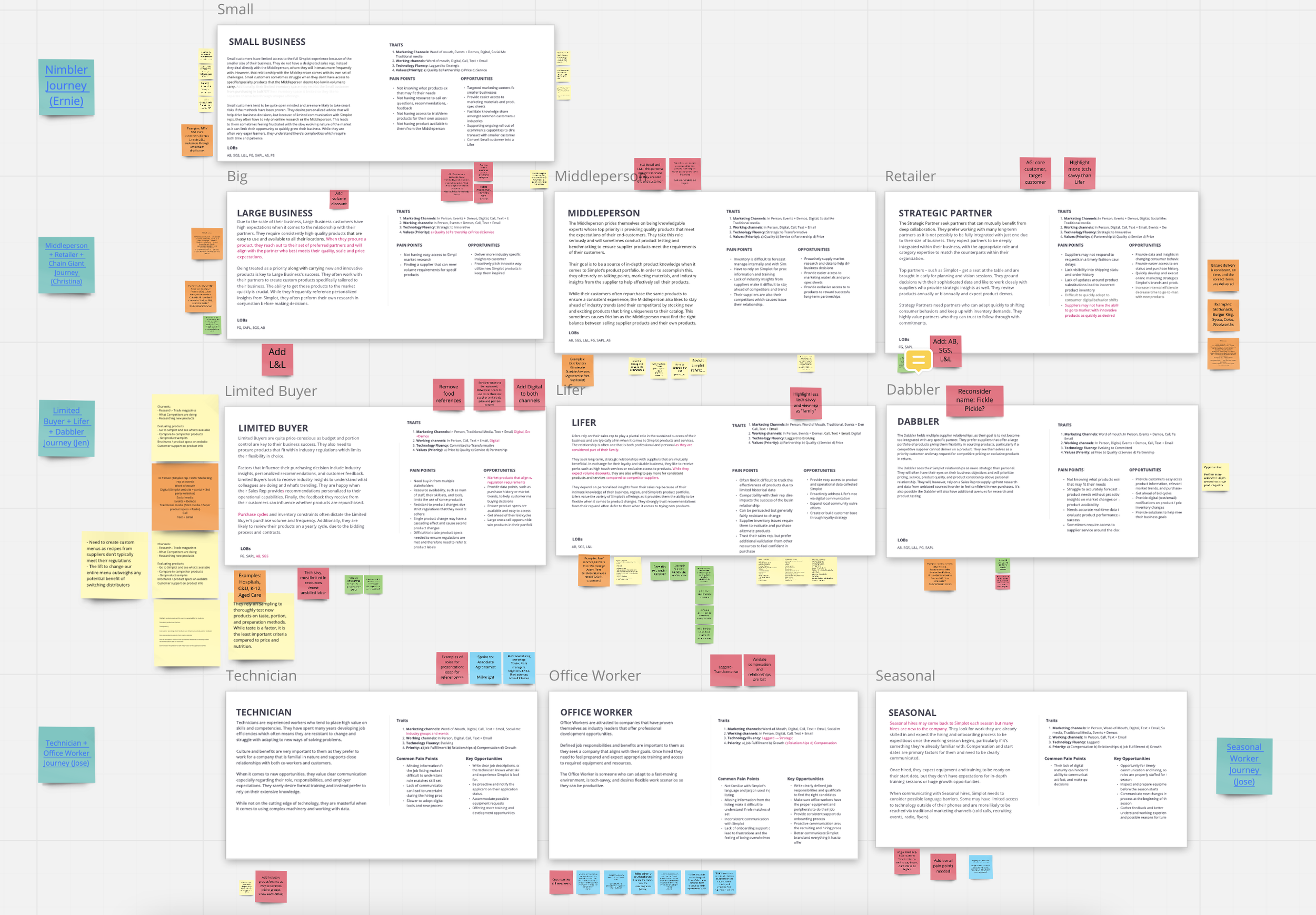
Persona co-creation in Miro — stakeholders from each division contributing institutional knowledge and validating research findings in real time
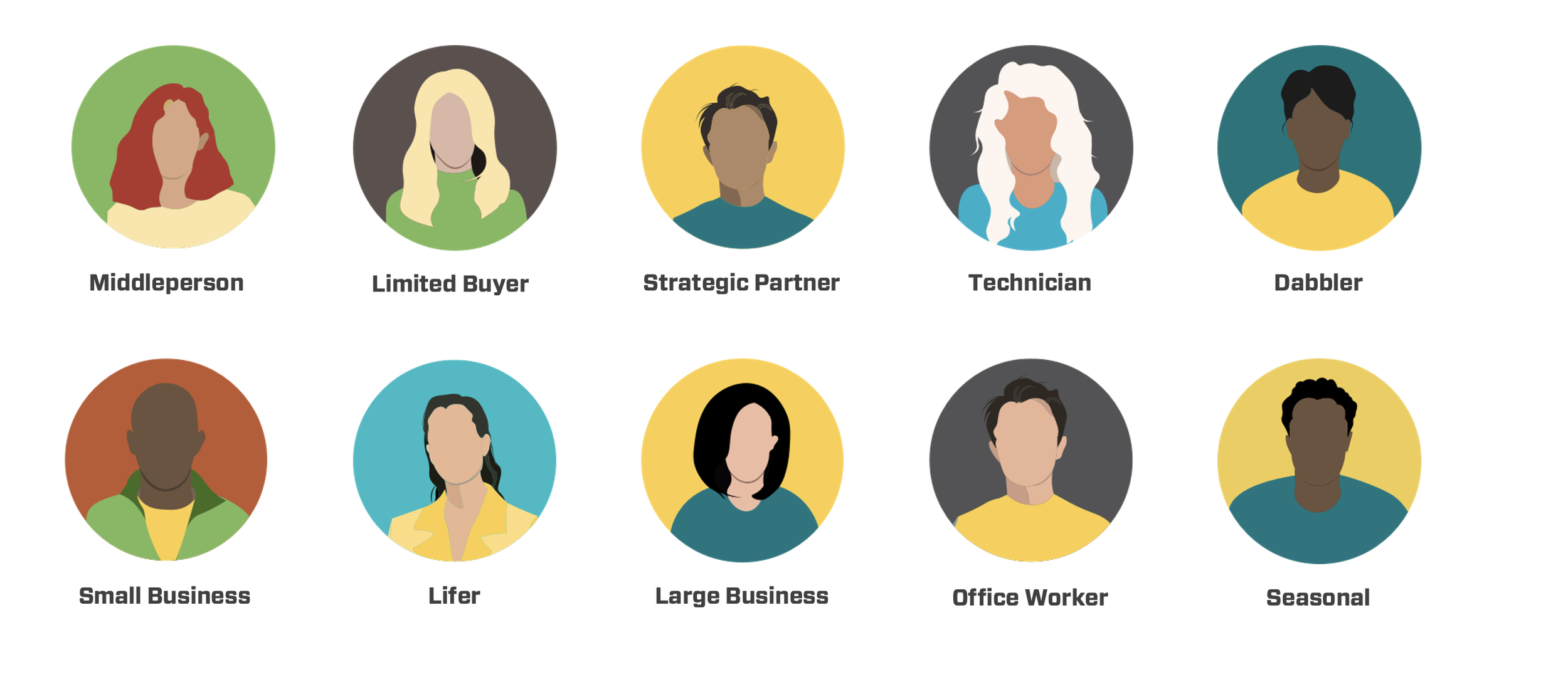
The final ten enterprise personas — from small-scale independent growers to large corporate buyers, spanning every major customer segment across Simplot's lines of business
Journey Mapping Workshops
With the persona framework validated, I led two structured journey mapping workshops — one for the Food Group, one for Agribusiness — designed to translate persona insight into operational understanding. These sessions were built around a specific goal: getting Simplot's teams to see their customers' experience as a continuous arc, not a series of discrete transactions.
"By working through the journey with Simplot's people, the maps reflected both what the research showed and what the business understood about its own operations — producing artifacts that were immediately credible rather than documents that would sit on a shelf."
We mapped common pathways across customer types, identified the friction points where Simplot was losing trust or momentum, and surfaced intervention opportunities with the highest potential impact across segments. The workshop format was deliberate: a journey map co-created with the people who operate the business carries organizational weight that a consultant-produced document rarely does. Simplot's teams left the workshops with a shared view of their customer experience that they had built themselves — which meant they were prepared to act on it.
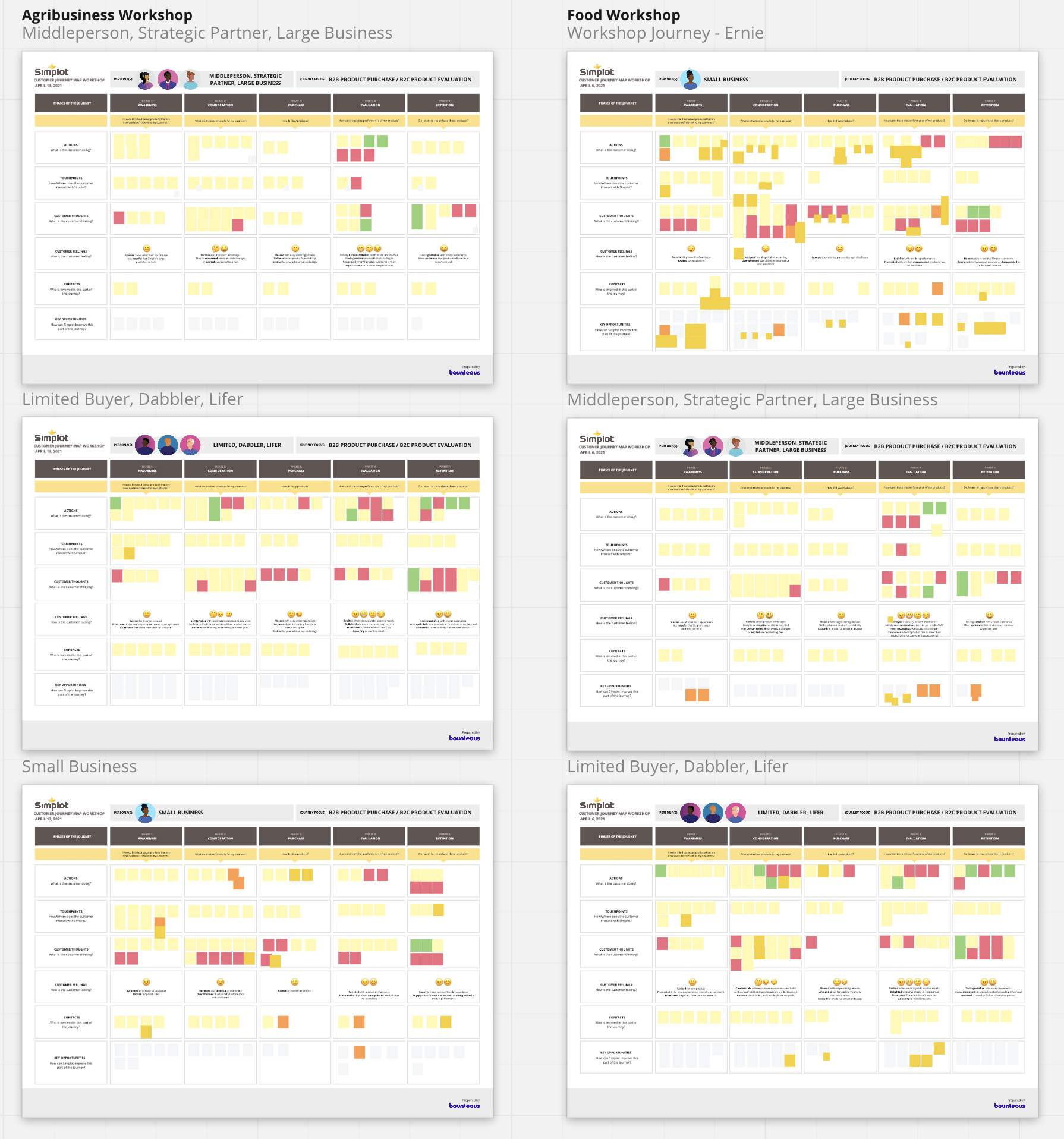
Journey mapping workshops — Food Group and Agribusiness sessions, run simultaneously across persona groupings: Middleperson / Strategic Partner / Large Business, Limited / Dabbler / Lifer, and Small Business
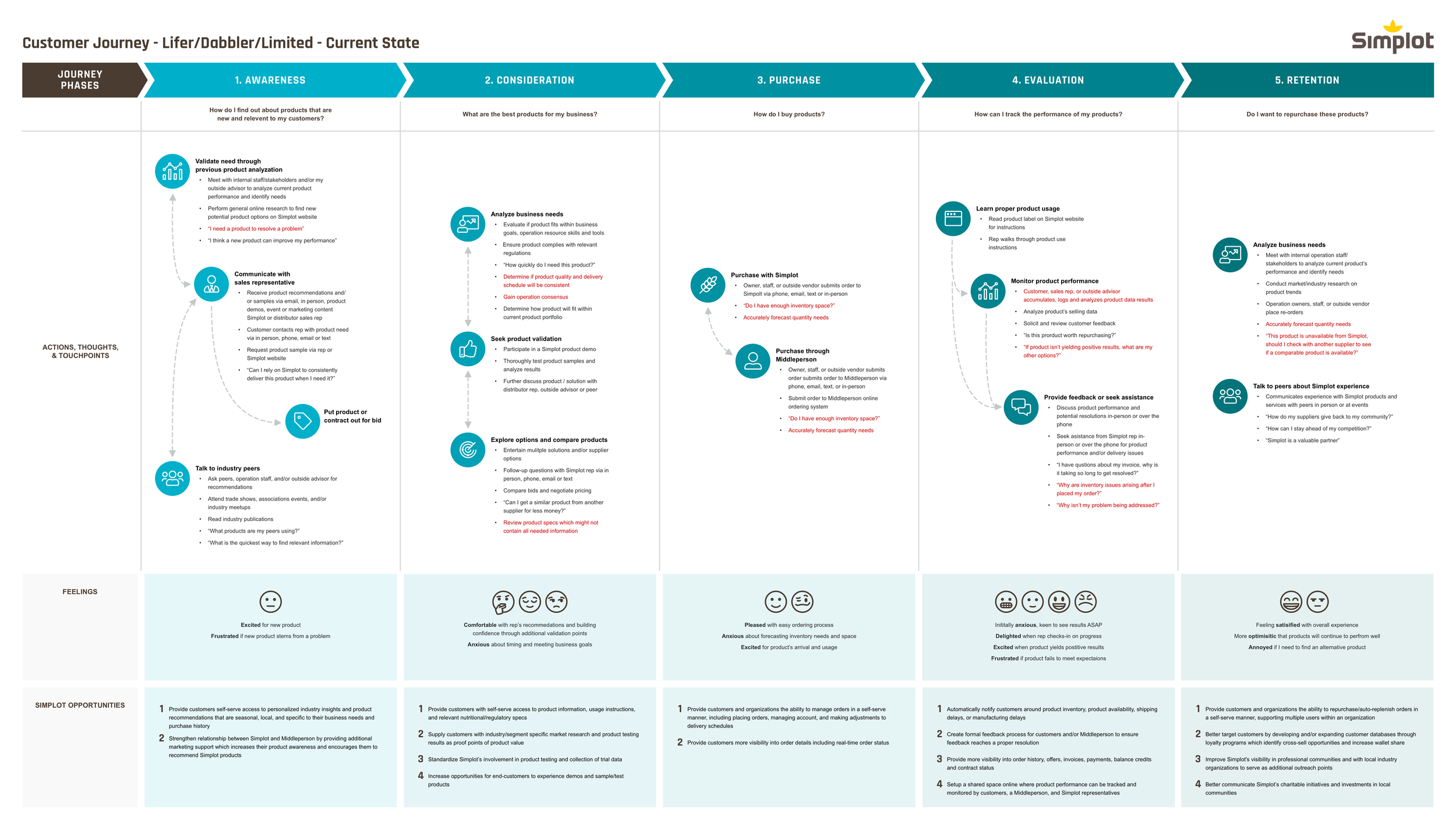
Lifer / Dabbler / Limited Buyer journey map — current-state experience across five phases, with friction points and Simplot opportunity areas explicitly called out at each stage
Outcomes & Impact
The three-month Discovery engagement delivered the foundational assets Simplot needed to pursue the One Simplot vision with organizational alignment and strategic clarity — and established the decision-making infrastructure for everything that followed.
10 Enterprise Personas
A validated, enterprise-wide customer framework spanning every major segment across Simplot's lines of business — built from primary research and co-created with divisional stakeholders to ensure adoption. Each persona was designed to directly inform marketing campaigns, technology implementations, website strategy, and content development. A single source of truth replacing years of siloed, division-specific assumptions.
5 Customer Journey Maps
Clear visualizations of the end-to-end customer experience for Simplot's primary segments, with friction points and opportunity areas explicitly mapped and prioritized — giving each division a concrete view of where to focus improvement efforts first and a shared language for communicating customer needs across the organization.
Four Strategic Priorities
Self-service infrastructure, targeted marketing delivery, expertise accessibility, and proactive communication — each grounded in direct customer evidence and sequenced for implementation. A roadmap built from what customers said, not what internal teams assumed, with specific opportunity areas identified for each priority.
Job Seeker Research Track
Alongside the customer program, a parallel discovery track with HR leaders and new hires surfaced a separate set of themes around job posting quality, application experience, and onboarding friction. The finding: customer-facing transformation requires internal alignment first. Simplot couldn't improve the customer experience without also improving the employee experience that produces it.
Foundation for One Simplot
A shared customer understanding that gave Simplot's leadership a common language and evidence base for enterprise-wide decisions — the prerequisite for any meaningful digital transformation across a business operating across four continents and eight lines of business. The engagement ended with organizational alignment that hadn't existed before it started.